

War! What Is It Good For? Scaring You!
With headlines dominated by geopolitical tensions and recent U.S. military actions, investors are once again asking a familiar question: What does war mean for markets?
Data from Nasdaq Dorsey Wright provides historical context by analyzing how various asset classes have behaved following major U.S. military escalations over the past century. The findings may surprise investors who instinctively associate conflict with prolonged market declines.
Short-Term Shock, Long-Term Resilience
History suggests that markets often react negatively in the immediate aftermath of major military events – but those declines are typically short-lived. For example, following the attack on Pearl Harbor in 1941, the S&P 500 experienced its worst short-term reaction in the dataset, falling more than 6% over the next five days.
However, beyond those initial shocks, markets have generally demonstrated resilience.
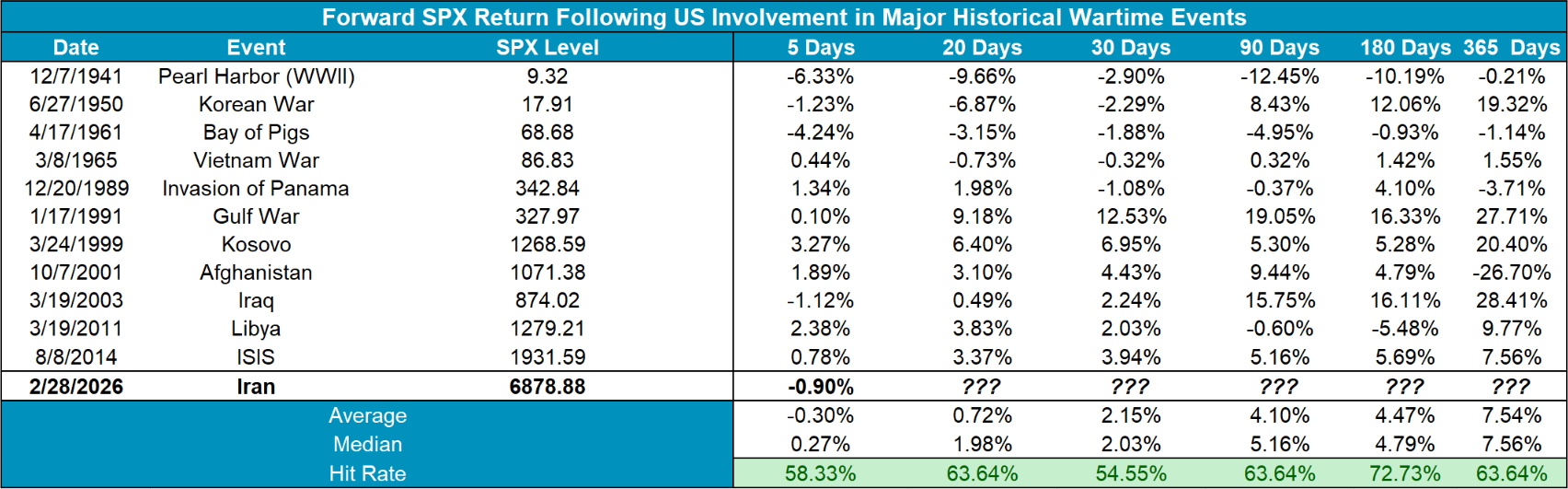
Source: Nasdaq Dorsey Wright, “A Historical Guide to Asset Class Performance Around Wartime,” 3/4/2026
The study suggests that uncertainty – rather than conflict itself – has often been the primary driver of early market volatility. As new information is digested and expectations stabilize, markets tend to recalibrate and move forward.
This aligns with a broader concept: markets are forward-looking. They generally price in expectations rapidly, and once the initial uncertainty fades, investors often refocus on fundamentals like earnings, interest rates, and economic growth – however flawed that approach may be in the eyes of a trend follower, but I digress.
Asset Class Behavior: Not All Assets Respond the Same
One of the highlighted insights in the study is that different asset classes have responded distinctly to geopolitical events. For example:
Equities: While stocks may initially sell off, they have historically recovered and often delivered solid returns over the following months and year.
Commodities (especially energy): Crude oil has frequently been a strong performer during conflict periods, which makes intuitive sense given that many geopolitical tensions involve energy-producing regions.
Emerging Markets: You may find it interesting that emerging markets have often shown strong performance following U.S.-led conflicts, despite expectations that they might be more vulnerable.
A broad takeaway is that most asset classes exhibit more resilience than investors expect during periods of geopolitical stress.
The key message is that markets can function as adaptive systems. While narratives around war can feel uniquely alarming in the moment, history suggests that financial markets are remarkably capable of absorbing and adjusting to these events.
Context Matters More Than Headlines
Another nuance highlighted in the research is that wars of today look different than decades ago. Modern conflicts are often less clearly defined, more prolonged, and influenced by rapid information flow.
As a result, direct comparisons between past and present events can be challenging. However, the broader patterns still hold: initial volatility followed by normalization.
For investors, this reinforces the importance of context over reaction. Headlines may drive short-term sentiment, but long-term outcomes are shaped by economic fundamentals and market structure – not just geopolitical events.
The Case for Trend Following
Times of uncertainty – like wartime environments – are when trend following can become especially valuable, in our firm’s view. Rather than attempting to predict how markets should react to geopolitical developments, trend following focuses on how markets are actually behaving. It allows investors to respond to real-time price movements rather than headlines or emotions.
The trend-following discipline can be particularly powerful if:
Risk assets are declining - because trend-following strategies systematically reduce exposure
Markets stabilize and begin to recover - because those same strategies can re-engage as trends improve
Leadership shifts (e.g., toward commodities or defensive sectors) – because trend following can help capture those rotations
In other words, trend following doesn’t require investors to be geopolitical experts. Instead, it provides a rules-based framework that adapts to changing conditions, which can help remove emotion from the decision-making process at precisely the time when anxiety tend to run highest.
Staying Grounded in a Noisy Environment
A key takeaway from the Nasdaq Dorsey Wright research is not about any single asset class, but about investor behavior. Periods of geopolitical tension often lead to heightened anxiety and reactive decision-making. Yet history suggests that markets are far more resilient than the headlines suggest.
For long-term investors, this creates both a challenge and an opportunity:
The challenge is avoiding emotionally driven decisions during periods of uncertainty.
The opportunity is maintaining discipline while others overreact. Whether through diversified portfolios, systematic strategies like trend following, or simply maintaining a long-term perspective, the goal remains the same: stay aligned with a process rather than the news cycle.
Final Thought
War and geopolitical conflict are undeniably serious events with real-world consequences. But from a market perspective, history suggests a more measured interpretation: volatility is common, but lasting damage is far less so.
For investors, one takeaway is that while uncertainty can drive markets in the short term, long-term outcomes are often shaped by a disciplined approach. And in environments like these, having a process you trust may be more valuable than any prediction you can make.
Disclosures:
Blueprint Financial Advisors (“Blueprint”) d/b/a Miller Wealth Partners is an investment adviser registered under the Investment Advisers Act of 1940. Registration as an investment adviser does not imply any level of skill or training. For more information, please visit adviserinfo.sec.gov and search for our firm name. All content available on this website is general in nature, not directed or tailored to any particular person, and is for informational purposes only. Neither the website nor any of its content is offered as investment advice and should not be deemed as investment advice or a recommendation to purchase or sell any specific security. Blueprint does not represent that any opinion or projection will be realized. Neither Blueprint nor any of its advisers, officers, directors, or affiliates represents that the information presented on this website is accurate, current or complete, and such information is subject to change without notice.
Information obtained from third-party sources is believed to be reliable though its accuracy is not guaranteed.
Information contained on third party websites that Blueprint may link to is not reviewed in their entirety for accuracy and Miller Wealth Partners assumes no liability for the information contained on these websites.
Opinions expressed in this commentary reflect subjective judgments of the author based on conditions at the time of writing and are subject to change without notice. The above commentary is for informational and educational purposes only and should not be construed as investment advice or a recommendation to buy or sell any security.
No part of this material may be reproduced in any form, or referred to in any other publication, without express written permission from Miller Wealth Partners.